
The Woolcock Institute of Medical Research
Expanding monitoring to guide policy
An important study monitoring three measures of air pollution may help guide the future of our cities including where we live, work and play and how we travel.
Air pollution is most commonly reported through a single metric: fine particulate matter or PM2.5. That’s because PM2.5 is consistently measured and strongly linked to adverse health outcomes, particularly cardiovascular and respiratory disease.
However, PM2.5 is part of a much more complex picture. It captures the total mass of fine particles (less than 2.5 microns (μm) in diameter) in the air, but does not distinguish between different particle types, sources or behaviours. Included in the PM2.5 umbrella are sub-categories that provide additional information about exposure and risk. Two of the most important are black carbon and ultrafine particles (UFPs).
Black carbon is considered to be one of the best markers of combustion-related particulate matter (e.g. traffic pollution, fires, diesel), and together with ultrafine particles (UFP) is a good marker of traffic-related air pollution. Due to their very small size (<0.1 μm diameter), UFPs are considered to be one of the most harmful components of traffic related pollution and, together, the two pollutants are considered by the World Health Organisation (WHO) to be more relevant to human health than PM2.5 alone, with evidence of both short and long- term effects.
However, these pollutants are not monitored as part of regulatory monitoring programs, either here or elsewhere worldwide. Therefore, aside from local project monitoring which has occurred during: bushfire events; to study exposure during different transport modes or corridors; at schools or for personal exposure studies; to date, there has been little black carbon or UFP monitoring conducted in Australia to specifically determine pollution levels across different urban areas.
Given their interest in traffic-related air pollution, Dr Christine Cowie and Professor Guy Marks, researchers at the Woolcock and with the NHMRC Centre for Safe Air, are currently conducting a study to record the variation in these air pollutants.
Want to stay up to date with our research on sleep and respiratory conditions?
Sign up to our quarterly newsletter
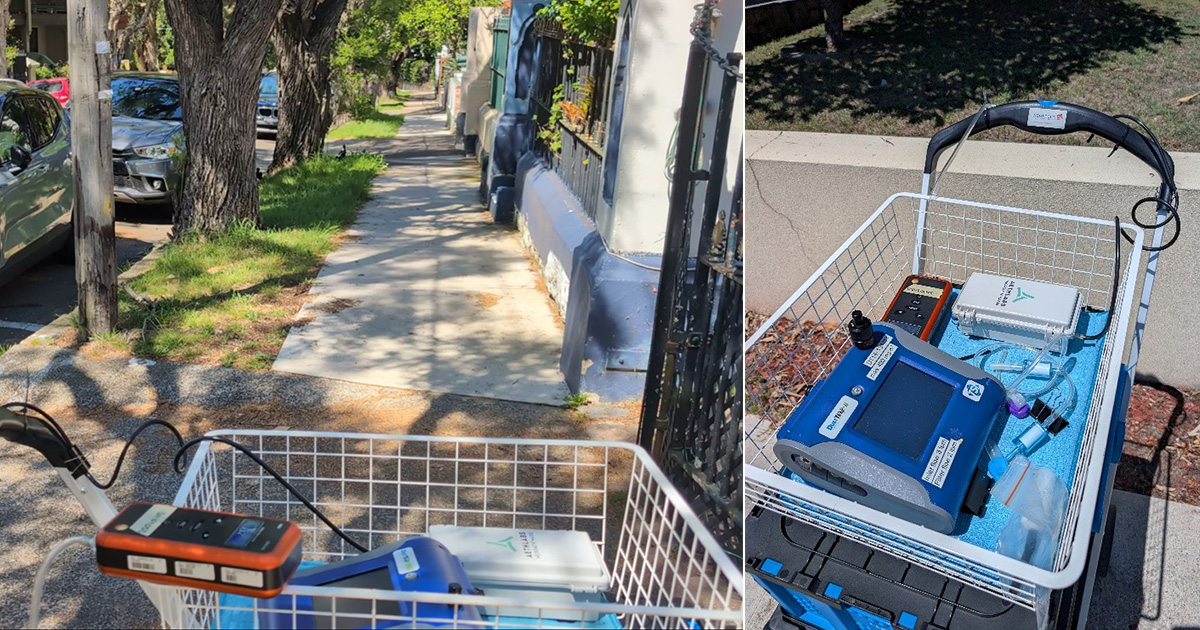
Over the summer, autumn and winter periods, pollutant measurements are being recorded at 72 sites around the Sydney metropolitan area, with each site being measured on at least 18 occasions over different times of the day, different days of the week, and over various seasons, in order to obtain a representative sample of the pollutants.
The study findings will have ramifications for some of the biggest challenges facing our cities. Traffic pollution is a large contributor to air pollution and, although we are moving towards adoption of electric vehicles, Australia is still some decades off achieving this goal. In the meantime, planning authorities in many of our major cities are promoting urban consolidation for new housing, oftentimes along major road transport corridors where we expect population exposures to traffic pollution to increase. This can be expected to have a direct impact on health with increased risk of respiratory, cardiovascular and metabolic disease and increased risk of mortality all known to be linked to increased exposure to traffic.
Our hope is that this study will be used to help inform public policy and guide land use planning choices or air pollution mitigation measures when considering development applications for buildings which house vulnerable populations such as childcare centres, schools and aged care institutions. They may also help guide public policy with respect to transport choices and the selection of safer routes for active commuting.
Find out more
Share online
Donate
We are committed to understanding and eradicating these conditions. If you would like to support our research please click the donate button.

Subscribe
Sign up with your email address to receive quarterly newsletter updates, including the latest medical findings and breakthroughs in respiratory and sleep research.
We Need Volunteers for our research











PRIVACY: The Woolcock Institute of Medical Research recognises the importance of your personal information and privacy. We will use your provided details only to contact you about information we believe will be of interest to you. Read our full Privacy Policy.
Woolcock Institute of Medical Research is a not-for-profit charity. Donations of more than $2 are tax deductible. Copyright © 2026. ABN: 88 002 198 905